How to Use a Sauna Heater: Temperature, Timing, and Etiquette for Beginners

A beginner sauna session should start at 150 to 160°F for 5 to 10 minutes, working up to the more typical 170 to 190°F over several weeks as heat tolerance improves. Ladle water onto the stones in small amounts, roughly a quarter cup at a time, to avoid a steam burst that’s uncomfortably hot. Basic etiquette rules stay consistent across almost every setting: rinse off before entering, sit on a towel, keep noise low, and never touch or adjust someone else’s heater controls in a shared space without asking.
What Temperature Should You Actually Start At?
Experienced sauna users often run heaters at 180 to 190°F, but that range can feel overwhelming the first few times, especially if you’re not used to sustained heat exposure. Set the thermostat to 150 to 160°F for your first two or three sessions and pay attention to how your body responds. Once you can comfortably stay in for 10 minutes at that range without feeling lightheaded, raise the target by 10 degrees and repeat. Most heaters with digital controls hold temperature within a couple of degrees once the stones are fully heated, which usually takes 20 to 40 minutes depending on the unit’s kW rating and the cabin’s insulation.
How Long Should You Stay In?
Five to eight minutes is a reasonable ceiling for a first session. Step out immediately if you feel dizzy, nauseated, or your heart is pounding harder than expected; those are signs to cool down, not push through. Regular users typically build up to 15 to 20 minute sessions, often broken into two rounds with a cool-down break in between rather than one long continuous sit. Hydrate before and after, not heavily during, since a full stomach or too much water right before entering can cause discomfort as your core temperature rises.
How Do You Use the Stones and Water Correctly?
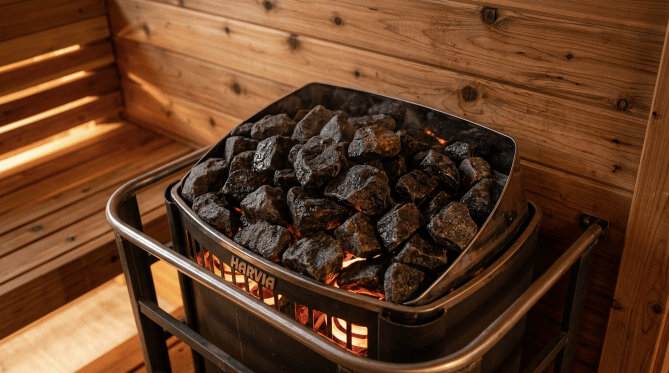
Löyly, the steam created by pouring water on hot stones, is what most people associate with a proper sauna. Use a wooden ladle and pour a small amount, around a quarter cup, directly onto the center of the stone pile rather than the edges or the heater housing. Pouring too much at once creates a rush of steam hot enough to sting exposed skin and can shock the heating element over time. Wait at least a minute between pours so the room has a chance to absorb the humidity rather than stacking steam on steam. Plain water is standard; scented sauna water or essential oil blends are fine in small amounts but should never be poured directly on the element housing, only on the rock bed itself.
What Are the Basic Clearance and Safety Habits to Build?
Most heaters need a guard rail or fixed clearance, often 3 to 4 inches minimum, between the hot surface and any bench, wall, or towel. Learn where that boundary is in your own cabin and keep towels, robes, and loose items away from it, since fabric draped over a guard rail is one of the more common causes of home sauna scorching. Never leave young children unsupervised near a running heater, and never use electrical accessories like phones or speakers inside the hot cabin unless they’re explicitly rated for sauna use, since heat and humidity both shorten the life of standard electronics.
What Does Sauna Etiquette Actually Look Like?
Etiquette matters more once more than one person uses the sauna, whether that’s family members or a shared gym setting. Shower before entering to rinse off sunscreen, lotion, or heavy sweat, all of which can smoke slightly on a hot heater and leave a residue. Sit on a towel rather than directly on the bench, both for hygiene and because bare skin on hot wood after 15 minutes can be uncomfortable. Keep conversation at a low volume; a sauna is one of the few places where quiet is the default expectation, not an exception. If you’re sharing the space, ask before adjusting the temperature or adding water to the stones, since someone already inside may be at their limit. Phones generally stay outside or face down and silent.
See also: The Evolution of Technology: Shaping Our Future
How Should You Cool Down Afterward?
Step out and let your body temperature drop gradually rather than jumping straight into ice water on your first few sessions. A cool shower, a few minutes sitting in open air, or a short cold plunge once you’re more experienced all work. Rehydrate with water, and avoid alcohol immediately before or after a session since it interacts poorly with heat-related blood pressure changes. Give yourself a few minutes to fully cool before doing anything that requires sharp balance or coordination, like driving.
What Should You Check Before Your First Real Session?
Confirm the heater is fully preheated, not just showing a target temperature on the display but actually holding it, since some units read the set point before the stones have caught up. Check that the guard rail is secure and that nothing flammable is draped nearby. If you bought a new heater recently, checking the SweatDecks catalog or the manufacturer’s own documentation can tell you the specific break-in period, since some units need an initial curing burn to clear off manufacturing residue before the first real session.
What Should You Wear, or Not Wear, Inside?
Home saunas vary by household, but a towel wrapped around the body or laid across the bench is the common baseline, both for hygiene and comfort against hot wood. Swimwear is standard in most shared or mixed-gender settings; some households and traditional sauna cultures go without, but that’s a personal or household decision, not a universal rule. Whatever you wear, avoid synthetic fabrics that trap heat unevenly or metal jewelry, which can heat up enough to be uncomfortable or even cause a minor burn against skin during a longer session. Bare feet or simple sandals work better than closed shoes, which trap sweat and don’t tolerate the heat well over repeated use.
Frequently Asked Questions
What temperature should a beginner set a sauna heater to? Start around 150 to 160°F rather than the 190°F some experienced users prefer. You can raise it a few degrees each session as your tolerance builds.
How long should a first sauna session last? Five to eight minutes is enough for a first session. Step out sooner if you feel dizzy, nauseated, or unusually short of breath.
How much water should you pour on the stones at once? A small ladle, roughly a quarter cup, is plenty. Pouring more than that in one go can send a burst of steam hot enough to be uncomfortable or even cause a minor burn near the heater.
Is it rude to talk loudly in a shared sauna? In most shared or public settings, yes. Quiet conversation is generally fine, but loud talking, phone calls, and phone screens are considered poor etiquette in almost every sauna culture.
Should you shower before or after using the sauna? Both. A quick rinse before removes lotions or sunscreen that can smoke on the heater, and a shower after helps you cool down and wash away sweat.
References
- Kunutsor, S. K., et al. “Clinical Effects of Regular Dry Sauna Bathing: A Systematic Review.” Evidence-Based Complementary and Alternative Medicine, 2018. https://pubmed.ncbi.nlm.nih.gov/29849692/
- “Benefits and Risks of Sauna Bathing.” The American Journal of Medicine, 2001. https://pubmed.ncbi.nlm.nih.gov/11165553/
- Hannuksela, M. L., Ellahham, S. “Effects of Heat and Cold on Health, With Special Reference to Finnish Sauna Bathing.” American Journal of Physiology – Regulatory, Integrative and Comparative Physiology, 2018. https://pubmed.ncbi.nlm.nih.gov/29351426/
- National Fire Protection Association. https://www.nfpa.org/
By Derek Holloway